
What comes to mind when you think of personal protective equipment in winter? Most likely warm clothing, sturdy footwear, and gloves to keep out the cold. But what about safety glasses? Here we present models with innovative technologies that make working easier even in snow and ice.
4.1, 270, 156.
Unfortunately, these are not the lottery numbers for the coming weekend, but statistical cornerstones of the winter 23/24 in Germany: 4.1 degrees Celsius was the average temperature, 270 liters of precipitation fell per square meter, and the Germans enjoyed 156 hours of sunshine. Regardless of the fact that the first two values were significantly higher than the long-term average, the data from the German Weather Service shows how challenging winter is for everyone working outdoors. It’s cold, sometimes even icy, it’s wet, it snows, and occasionally the sun appears.
Protect your eyes in the cold
It’s no surprise that most people dress appropriately during the cold season, both privately and professionally, given these conditions. No one would think of stepping outside wearing only a T-shirt or flip-flops. You need proper footwear, warm clothing, gloves, and a head covering. In the workplace, there are even clear regulations: DGUV Rule 112-189 of the German Social Accident Insurance stipulates that employers must provide suitable equipment to protect employees from moisture, wind, and cold. At temperatures down to minus five degrees, so-called weather protection clothing is required; at lower temperatures, cold protection clothing must be provided.
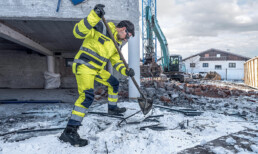
The terms “eyes” or “safety glasses” are missing from this regulation. Yet our most important sensory organ also needs special protection in winter. The drier air – indoors and outdoors – causes tear fluid to evaporate more quickly. It’s important to prevent icy wind from blowing into the face. And snow poses an even greater danger: while the natural green of plants in summer reflects only six percent of light, snow under sunlight reflects almost 95 percent. Without protection against this intense glare, working becomes impossible and the eye suffers long-term damage. Conditions such as conjunctivitis or even more severe diseases up to retinal damage can result.
uvex: Decades of PPE experience
As a German manufacturer of personal protective equipment, uvex has a long-standing expertise when it comes to professional eye protection. Philipp M. Winter founded the company in 1926 as a one-man business, initially trading in all kinds of safety glasses. Today, his grandson Michael Winter runs the nearly 100-year-old traditional company, which has long since expanded beyond eye protection.
Our PPE products now cover everything from head to toe, without diminishing our commitment and innovative strength in safety glasses. uvex eye protection products feature numerous technologies that deliver full performance even under winter conditions.
Fog-free Anti-Fog Coating
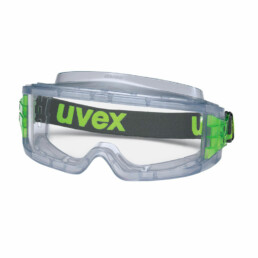
The uvex supravision coating technology and its Anti-Fog coating ensure that eye protection does not fog up – a problem every glasses wearer knows when moving from cold to warm environments. The uvex supravision plus coating solves this by keeping lenses fog-free (and scratch-resistant) for a very long time on both sides. Even after multiple cleanings, the anti-fog effect does not wash off. For example, the uvex ultravision remains fog-free even at minus 30°C and protects the eye area from icy wind thanks to this technology.
Tinting
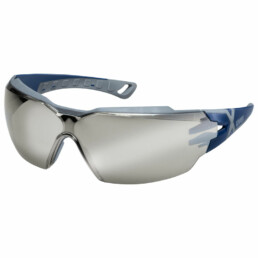
For work in snowy conditions, we recommend safety glasses with strongly tinted lenses, such as the uvex pheos cx2 model. With only 12% transmission, it offers very high glare protection against strong sunlight and reflections. The additional optimal signal color recognition ensures safe and unobstructed vision. Transmission describes light permeability, which should be low under intense glare and sunlight reflected by snow to protect the eyes. Otherwise, snow blindness may occur, which in the worst case can lead to permanent damage.
UV Protection
All uvex safety glasses come with UV protection as standard. While the industry standard requires protection up to 380 nanometers, the Franconian PPE manufacturer goes a step further and guarantees UV protection up to 400 nanometers. This provides complete protection against harmful UV radiation.
Full protection with goggles
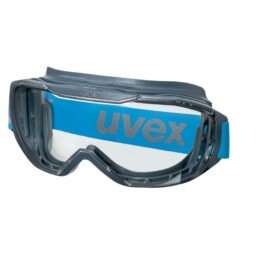
To best protect eyes from adverse winter conditions such as wind and moisture, it is advisable to use goggles with a soft, flexible face seal. One such model is the uvex megasonic, which resembles ski goggles in design. This is no coincidence, as sports are uvex group’s second major pillar alongside occupational safety. Bicycle, ski, and riding helmets are part of the portfolio, as are ski goggles. This gives uvex a decisive advantage, as the different divisions benefit enormously from knowledge transfer – ultimately benefiting customers as well.
uvex variomatic
An example of uvex’s innovative strength in both worlds is the uvex variomatic technology. Photochromic lenses react within seconds to changing light conditions, darkening gradually with increasing brightness (UV radiation) or lightening gradually as it gets darker. What helps skiers avoid changing goggles multiple times a day can also be a very convenient feature at work. Among others, the uvex sportstyle safety glasses offer this technology.
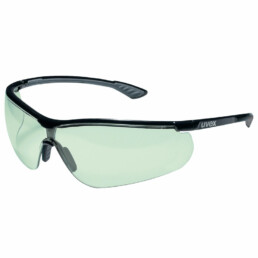
No matter how cold it gets, how much snow falls, or how long and intensely the sun shines: it’s important to adapt your personal protective equipment to the weather conditions. In summer as well as in winter.